Minimum Daily Requirements:

First in a series on

“Responsible Social Media Citizenship”

For solid research on what you accept as truth, you need to learn:

• who it is that is telling you something,

• why they are telling it to you,

• and what do those who disagree have to say.

This is the basics—the minimum—on learning to be accurately informed.

Real truth is nothing to be afraid of.

Why this series? Why now?

While watching a YouTube video that made some good points about comparing the viewpoints and biases of various news articles and resources, it was so obvious to me that even though the video narrator thought they were coming at it from an unbiased direction and that they were just simply presenting facts, they were not. The fact of the matter is that no one presents information in an entirely bias-free manner. Of course trying to do so is better than trying to manipulate with misinformation, disinformation, or non-information (see “Why is ID important?”). Lying, scamming, tricking, and intentionally misleading people to prevent them from learning accurate information is abhorrent, no matter how common we find it around us. Being aware of the difference between these bad and manipulative communication methods is going to be a starting point when it comes to keeping those who curate and share information on a path of well-supported research.

However, the responsibility rests on the person reading the website, app, blog, news article, or YouTube video to sieve through the information glut and test what is presented to you. To be a responsible social media citizen, you must take care in hearing and reading to test whether the communication deserves your precious trust in believing it—and especially—whether to pass it on to others.

And how will I know?

The answer to that question is what the series is about. As stated above, the bare minimum for being a responsible research-citizen has to do with how you approach some bit of information. Ask yourself those questions: “Who is telling me this?” “Why are they telling me?” and very importantly, “What do the people who disagree think?” If you can’t ascertain the answers to these questions, then you have no business sharing them with others. Even if you are a person who already wants to agree with some bit of information you are hearing or reading, you still need to understand all three of these things to be an effective and honest researcher.

It is all a part of loving the truth—which is why so many people say they want to share some informational tidbit they have read or heard: they want the truth to get out about something. However, if you don’t actually do the preparation to know and validate the truth of something before you believe it and share it with others, how much of a lover of truth are you? Not much; more than likely, you are a lover of what you already think, whether it is substantiated by accurate information or not.

People who think they are committed to getting the truth out hate to be thought of as liars, which is often what they call people who disagree with them. However, truth be told, when people pass on things that are not true, that is lying and it is liars who do it.

Social media and your ID goals

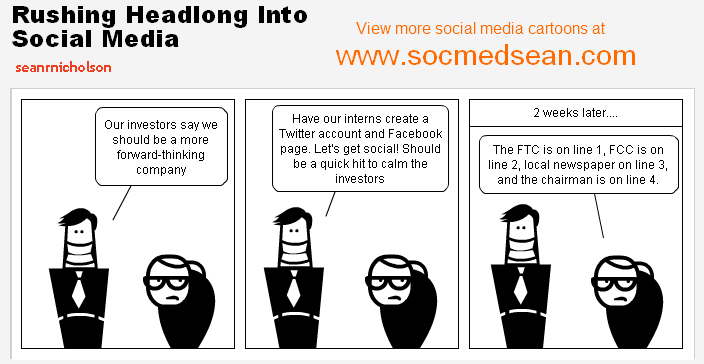
The limitations and disadvantages of using social media are especially obvious when poor planning or imprudent word choice leads to legal suits, firings, divorces, laughs on late-night comedy, politicians losing the public trust, and more, all because someone did not think before they posted. The saying that a carpenter should “Measure twice, cut once” should be applied to posting, in “Think twice—thrice, or more—then post.” A genie can’t be put back into the bottle after it is let out, so any comment or posting that you make online, whether done in an “on or off” professional attitude, can’t be undone.

Cartoon Image with 2 executives discussing social media without considering the consequences

SEAN R. NICHOLSON © COPYRIGHT 2012 SOCMEDSEAN
http://www.socmedsean.com/cartoon-rushing-headlong-into-social-media/

Avoiding this kind of trouble has layers beneath its surface: even when posting in a professional capacity—for example, posting comments as an editor on an editor’s forum—you can easily be misunderstood or forget to put yourself into the shoes of the audience or say something that has rhetorical implications that you did not realize at first. A quickly turned-out comment or posting might have negative consequences to you professionally if you don’t take the time to read (and reread) what you have written before you post.

Just like in all writing, you must analyze your posting according to: audience, tone, point of view, voice, vocabulary, grammar, and so on. Obviously, you should reflect your professional sound judgment by bias-free word usage, no typos, good graphics, etc. in all your social media interactions.

However, having said all that, posting on forums, commenting on blogs, tweeting, and using other interactive social media are great ways to make professional contacts, provided you understand the forum and its audience, and provided you contribute value to the discussion (i.e., where the audience values your contribution as much as you do). I personally have made some good professional editing contacts by judiciously posting on LinkedIn discussion forums about things within my sphere of expertise.

With that as a foundation, here is a major way that social media could support your ID goals: your social media comments can place your site and message within a context of the shared space of the whole professional community and its messages. In other words, use of social media gives you opportunities to project yourself both thoughtfully and with discretion and precision to impress an audience of users or at least increase your visibility. These users make up your target audience. Social media use helps you to keep up with your profession as it changes, as you follow those resources—whether individuals, publications, businesses—that let you in on cutting edge topics and new technologies, online spaces, discussions, problems, solutions, and change-leaders; social media use also lets you represent yourself or your business professionally.

You show your ability to contribute value to these discussions as you enter the shared space of your professional community, and then, you continue to update yourself as the space grows and changes. You link to what will benefit you and link others to that benefit; you update continuously to change along with the changes that are continuously happening around you.

—Susan LaVelle